
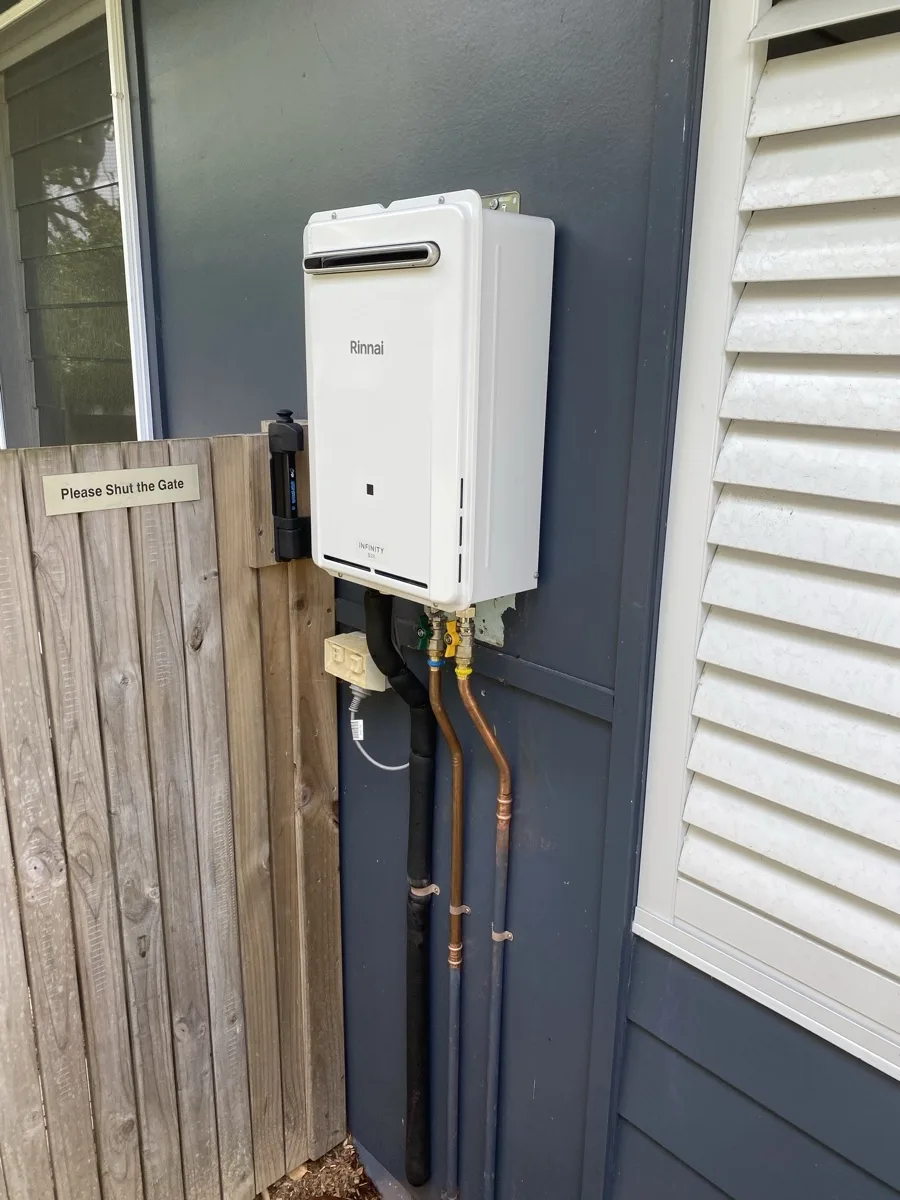
If your gas hot water system is on its last legs — or you’re building a new home and trying to decide what to install — you’ve probably come across two main options: continuous flow (also called instantaneous) and storage tank. Both use gas, but they work very differently.
Here’s an honest comparison from someone who’s installed hundreds of both across the Northern Beaches.
How They Work
Gas Storage
A gas storage system keeps a tank of water heated and ready to go at all times. A gas burner at the bottom of the tank fires up whenever the water temperature drops below the set point. This means the system is using energy even when you’re not using hot water — that’s called standing heat loss.
Gas Continuous Flow
A continuous flow system has no tank. When you turn on a hot tap, cold water flows through a heat exchanger where a gas burner heats it instantly. When you turn the tap off, the burner stops. No tank means no standing heat losses — you only pay for gas when you’re actually using hot water.
Running Costs
Because continuous flow systems don’t have standing losses, they’re more efficient. For an average 3–4 person household on the Northern Beaches:
- Gas continuous flow: about $1,094/year in the reference scenario
- Gas storage: about $1,285/year in the reference scenario
- The illustrative difference is about $191/year; actual equipment and usage can differ
Illustration for three people using the calculator's standard energy assumptions, no PV and AGL Ausgrid/Jemena reference rates checked 10 September 2026. Gas figures include the supply charge once when hot water is the only gas appliance. These are not measured household bills.
Want to see how gas compares to electric and heat pump options? Use our free Running Cost Calculator for a full comparison.
Open the Running Cost CalculatorWhen Gas Storage Makes Sense
- You need to supply multiple bathrooms simultaneously — a large storage tank can deliver high flow to several taps at once without temperature drop
- You have a very large household (5+) — big tanks (170L–400L) handle peak demand well
- Upfront budget is tight — storage units are generally cheaper to buy and install
- You already have a gas storage tank and want a straightforward replacement in the same location
When Continuous Flow Makes Sense
- You want lower running costs — no standing losses means less gas burned
- You’re short on space — the unit mounts on a wall, no bulky tank taking up the laundry or yard
- You need on-demand hot water within the unit’s rated flow and temperature-rise capacity
- You’re replacing an ageing storage tank and want to upgrade while you’re at it
- Your household is small to medium (1–4 people) — continuous flow handles this comfortably
What About Flow Rate?
The biggest consideration with continuous flow is flow rate — how many litres of hot water it can deliver per minute. A standard unit delivers 20–26L/min, which is enough for one shower plus a tap running at the same time. For larger homes, we can install higher-capacity units or even two units in series.
During our free on-site quote, we assess your household’s flow requirements — how many bathrooms, how many people, and whether you often run multiple hot taps at once. That way you get the right unit sized to your actual needs, not a one-size-fits-all recommendation.
Should You Consider Getting Off Gas Entirely?
A heat pump is another option to compare before replacing a gas unit. Use the running cost calculator with your household size and gas-account situation; its gas-only figures already include the supply charge.
With NSW government rebates available for heat pump installations, the upfront cost gap between gas and heat pump has narrowed. It’s a conversation worth having, and we can walk you through the numbers for your specific situation.
Not sure which direction to go? Call us on 0448 581 325 or request a free on-site quote. We’ll assess your home, your usage, and recommend the most cost-effective option — whether that’s gas or electric.
Request a Free Quote